LOUISIANALouisiana
The Pelican State. One state, one story: land, people, food, and the words locals really use.The Pelican State. Un estado, una historia: tierra, gente, comida y las palabras que la gente de ahí sí usa.

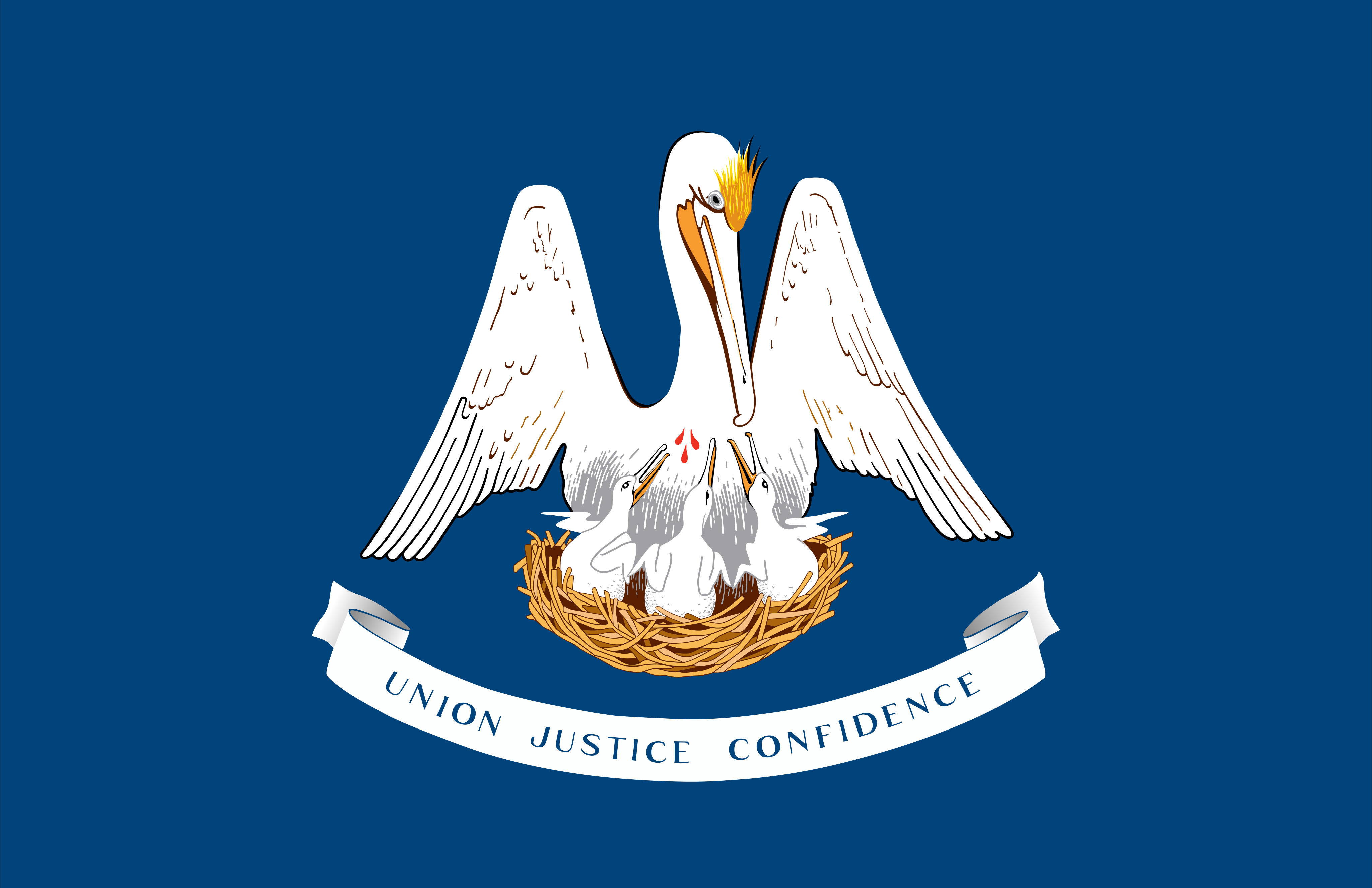
Say the state name, the capital, and the nickname out loud. Then tap Next.Di el nombre del estado, la capital y el apodo en voz alta. Luego toca Next.
Where is Louisiana?¿Dónde está Louisiana?
Louisiana is in the US South. The borders below are the ones to memorize.Louisiana está en Estados Unidos. Estos son los vecinos que hay que memorizar.
Baton Rouge, the capitalBaton Rouge, la capital

1 · The capital
Baton Rouge is the seat of government.Dato clave de Baton Rouge.
2 · Why here
Lawmakers picked a city they could reach.Los legisladores eligieron una ciudad a la que pudieran llegar.
3 · A civic fact
The capitol is the postcard of state power.El capitolio es la postal del poder del estado.
More detailMás detalle
Baton Rouge is the capital city of the U.S. state of Louisiana. It had a population of 227,470 at the 2020 United States census, making it Louisiana's second-most populous city. It is the seat of Louisiana's most populous parish, East Baton Rouge Parish, and the center of Louisiana's second-largest metropolitan area, Greater Baton Rouge, which had 870,569 residents in 2020.
Baton Rouge (pronunciación en inglés: /ˈbætən ˈɹuːʒ/; en francés: Bâton-Rouge pronunciado /bɑtɔ̃ ʁuʒ/; en español, Bastón Rojo) es la capital y segunda ciudad más poblada del estado estadounidense de Luisiana -por detrás de Nueva Orleans-. Se encuentra ubicada sobre la orilla oriental del río Misisipi, a pocos kilómetros de su desembocadura en el golfo de México, que forma el delta del Misisipi. Cuenta con una población de 227.470 habs. (censo 2020) y su área metropolitana alcanza los 750 000. De 2005 a 2007, fue la más poblada del estado, ya que se redujo significativamente la población de Nueva Orleans debido a la catástrofe del huracán Katrina.LandLand

High point
Driskill Mountain · 535 ft (163 m)Dato clave de la tierra de Louisiana.
The working land
Farms, forests, mines, or a coast, depending on the county.Granjas, bosques, minas o una costa, según el condado.
Water
A river, a lake, or an ocean wrote the old trade.Un río, un lago o un océano escribió el comercio viejo.
Person 1 · Louis ArmstrongPerson 1 · Louis Armstrong

1 · The name
Louis ArmstrongDato clave de Louis Armstrong.
2 · The deed
This is the person the class should be able to spell.Esta es la persona cuyo nombre la clase debe poder escribir.
3 · Place
Tie the name back to Louisiana.Dato clave de Louis Armstrong.
More detailMás detalle
Louis Daniel Armstrong (August 4, 1901 - July 6, 1971), nicknamed "Satchmo", "Satch", and "Pops", was an American jazz and blues trumpeter and vocalist. Among the most influential figures in jazz, his career spanned five decades and several eras in the history of the genre. Armstrong received numerous accolades, including the Grammy Award for Best Male Vocal Performance for "Hello, Dolly!" in 1965, as well as a posthumous win for the Grammy Lifetime Achievement Award in 1972. His influence crossed musical genres, with inductions into the DownBeat Jazz Hall of Fame, the Rock and Roll Hall of Fame, and the National Rhythm & Blues Hall of Fame, among others.
Louis Daniel Armstrong(Nueva Orleans, 4 de agosto de 1901-Nueva York, 6 de julio de 1971), conocido como Satchmo o Pops, fue un trompetista y cantante estadounidense de jazz. Se trata de una de las figuras más carismáticas e innovadoras de la historia del jazz y su músico más popular. Gracias a sus habilidades musicales y a su brillante personalidad, transformó el jazz desde su condición inicial de música de baile en una forma de arte popular. Aunque en el arranque de su carrera cimentó su fama como cornetista y trompetista, más adelante, su condición de vocalista le consagraría como una figura internacional de enorme influencia para el canto jazzístico.French QuarterFrench Quarter
- New Orleans' French Quarter mixes French, Spanish, African, and Caribbean food, music, and balconies in a few famous streets.El Barrio Francés de Nueva Orleans mezcla comida, música y balcones de Francia, España, África y el Caribe en unas calles famosas.
- Say it in one line: French Quarter is in Louisiana. Then say why people go there.Dilo en una línea: French Quarter está en Louisiana. Luego di por qué va la gente ahí.
More detailMás detalle
The French Quarter, also known as the Vieux Carré (UK: , US: , French: [vjø kaʁe]; lit. 'Old Square'), is the oldest neighborhood in the city of New Orleans. After New Orleans (French: Nouvelle-Orléans) was founded in 1718 by Jean-Baptiste Le Moyne de Bienville, the city developed around the Vieux Carré, a central square. The district is more commonly called the French Quarter today, or simply "The Quarter", related to changes in the city with American immigration after the 1803 Louisiana Purchase.
El Barrio Francés (en inglés: French Quarter; también conocido como Vieux Carré), es el más antiguo de la ciudad de Nueva Orleans, Estados Unidos. Después de que en 1718 Jean-Baptiste Le Moyne de Bienville fundara Nueva Orleans (La Nouvelle-Orléans en francés), la ciudad creció alrededor de la Vieux Carré ("Antigua Plaza" en francés), una plaza céntrica.The flagLa bandera
Look
Find the unique emblem, not only the blue field.Busca el emblema único, no solo el fondo azul.
Say it
The nickname is The Pelican State.Dato clave de la bandera de Louisiana.
Color
Ask one student to describe the flag without pointing.Pide a un estudiante que describa la bandera sin señalarla.
Food: three dishesComida: tres platos
gumbo
A dish to try in Louisiana. Say the name out loud: gumbo. Would you try it?Un plato para probar en Louisiana. Di el nombre en voz alta: gumbo. ¿Lo probarías?
po-boy
A dish to try in Louisiana. Say the name out loud: po-boy. Would you try it?Un plato para probar en Louisiana. Di el nombre en voz alta: po-boy. ¿Lo probarías?
beignet
A dish to try in Louisiana. Say the name out loud: beignet. Would you try it?Un plato para probar en Louisiana. Di el nombre en voz alta: beignet. ¿Lo probarías?

More detailMás detalle
Gumbo is a stew that is popular among the U.S. Gulf Coast community, the New Orleans stew variation being the official state cuisine of the U.S. state of Louisiana. Gumbo consists primarily of a strongly flavored stock, meat or shellfish (or sometimes both), a thickener, and the Creole "holy trinity": celery, bell peppers, and onions. Gumbo is often categorized by the type of thickener used, whether okra or filé powder (dried and ground sassafras leaves). Gumbo can be made with or without okra or filé powder. The preferred method in the historical New Orleans variation is with a French-inspired dark, even chocolate-like, roux.
El gumbo es el plato de referencia dentro de la gastronomía criolla y popular en los Estados Unidos. Es parte de la Cultura de Luisiana entre los criollos, en el sudeste de Texas, el sur de Misisipi y el Lowcountry de Carolina del Sur, Charleston (Carolina del Sur) y Brunswick (Georgia). Aunque se sirve en todas las épocas del año, se puede encontrar por regla general en los meses fríos. Se elabora en ollas en grandes cantidades y lentamente durante algunas horas.Louis ArmstrongLouis Armstrong
- Born in New Orleans in 1901, Armstrong's trumpet helped invent jazz, America's great musical gift to the world.Nacido en Nueva Orleans en 1901, la trompeta de Armstrong ayudó a inventar el jazz, el gran regalo musical de EE. UU. al mundo.
- Say it in one line: Louis Armstrong is from Louisiana. Then say what they are famous for.Dilo en una línea: Louis Armstrong es de Louisiana. Luego di por qué es famoso o famosa.
More detailMás detalle
Louis Daniel Armstrong (August 4, 1901 - July 6, 1971), nicknamed "Satchmo", "Satch", and "Pops", was an American jazz and blues trumpeter and vocalist. Among the most influential figures in jazz, his career spanned five decades and several eras in the history of the genre. Armstrong received numerous accolades, including the Grammy Award for Best Male Vocal Performance for "Hello, Dolly!" in 1965, as well as a posthumous win for the Grammy Lifetime Achievement Award in 1972. His influence crossed musical genres, with inductions into the DownBeat Jazz Hall of Fame, the Rock and Roll Hall of Fame, and the National Rhythm & Blues Hall of Fame, among others.
Louis Daniel Armstrong(Nueva Orleans, 4 de agosto de 1901-Nueva York, 6 de julio de 1971), conocido como Satchmo o Pops, fue un trompetista y cantante estadounidense de jazz. Se trata de una de las figuras más carismáticas e innovadoras de la historia del jazz y su músico más popular. Gracias a sus habilidades musicales y a su brillante personalidad, transformó el jazz desde su condición inicial de música de baile en una forma de arte popular. Aunque en el arranque de su carrera cimentó su fama como cornetista y trompetista, más adelante, su condición de vocalista le consagraría como una figura internacional de enorme influencia para el canto jazzístico.Driskill MountainDriskill Mountain

1 · Height
Driskill Mountain · 535 ft (163 m)Dato clave de Driskill Mountain.
2 · Metric
Feet and meters both appear. Use both.Aparecen pies y metros. Usa los dos.
3 · Climb?
Ask the class: walk, drive, or skip?Pregunta a la clase: ¿a pie, en carro o mejor no?
More detailMás detalle
Driskill Mountain is the highest natural summit in Louisiana, with an elevation of 535 ft (163 m) above sea level. It lies about 5.3 mi (8.5 km) southeast of Bryceland, in Bienville Parish. A large pile of rocks marks the high point. When comparing the highest point of elevation in each state, this mountain places Louisiana at third lowest - only Florida (Britton Hill) and Delaware (Ebright Azimuth) have lower highest points of elevation.
El punto más alto de Louisiana es Driskill Mountain. Compara su altura con un edificio o cerro que conoces.